
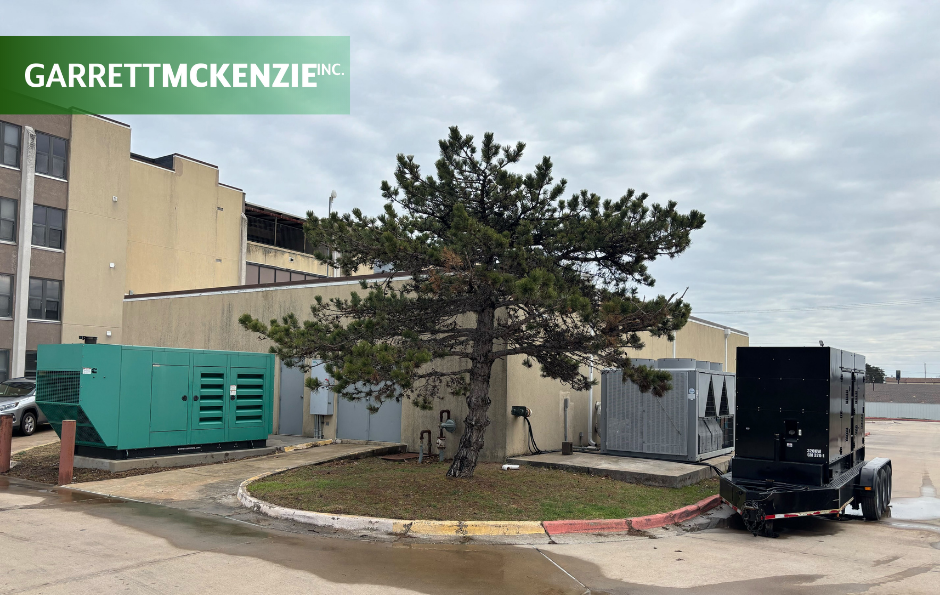
Types of Backup Power for Commercial Buildings (And How to Choose the Right One)
Not all backup power solutions are created equal. For most commercial buildings, the right backup power strategy depends on load requirements, outage duration, operational risk, and response time.
Understanding the main types of backup power helps facility managers, property owners, and contractors make informed decisions, and to do so before an outage forces one.
1. Standby (Permanent) Generators
What they are:
Permanently installed generators connected to the building’s electrical system through an automatic transfer switch (ATS). When utility power fails, the generator starts automatically.
Common fuels:
- Natural gas
- Diesel
- Propane
Best for:
- Hospitals and healthcare facilities
- Data centers
- Large commercial buildings with constant critical loads
- Facilities with strict uptime requirements
Key advantages:
- Automatic operation with little to no human intervention
- Designed for long-term, repeated use
- Can support large electrical loads
Some limitations to consider:
- High upfront capital cost
- Long lead times for permitting and installation
- Limited flexibility if your building needs change
- Ongoing maintenance responsibility
Something else to consider is that permanent standby generators are known to be excellent choices handling a consistent large load. But the downside is that if your power needs change, you are saddled with the capabilities of the size generator you have.
Even if you do have a backup power system, sometimes a permanent power backup can fail. You may need a “backup for the backup,” as this Garrett McKenzie project demonstrates: https://www.garrettmckenzie.com/resources/emergency-power-after-a-tornado/
2. Portable / Temporary Rental Generators
What they are:
Trailer-mounted or skid-mounted generators delivered as needed and connected to your building’s power distribution system.
Common fuels:
- Diesel (most common for commercial loads)
Best for:
- Emergency outages
- Planned shutdowns or maintenance
- Construction and renovation projects
- Buildings waiting on a permanent generator to be installed
- Facilities with temporary or seasonal power needs
Key advantages:
- Fast deployment
- No capital investment
- Scalable from small loads to multi-megawatt systems
- Can be paired with temporary power distribution and climate control
Some limitations to consider:
- Requires planning for connection points and distribution
- Needs fuel management during extended outages
- Something else to consider is that many facilities find out at the worst time that their permanent generator is undersized, typically following a power outage. Temporary generators allow facility managers and building owners to supplement or replace capacity immediately.
For an example of how Garrett McKenzie has responded to a company awaiting their permanent power system to be activated, see this past project: https://www.garrettmckenzie.com/resources/temporary-power-and-distribution-for-facility/
3. Uninterruptible Power Supply (UPS) Systems
What they are:
Battery-based systems that provide instant, short-duration power until another backup source comes online.
Best for:
- Server rooms and data centers
- Medical equipment
- Security and communications systems
- Control systems that cannot tolerate even momentary interruption
Key advantages:
- Zero-delay power transfer
- Protects sensitive electronics from power fluctuations
- Bridges the gap between outage and generator startup
Some limitations to consider:
- Very limited runtime (minutes, not hours)
- Not designed to power entire buildings
- Batteries degrade over time
Important clarification:
A UPS is not a replacement for a generator. They are a supporting component of a complete backup power strategy.
4. Load-Specific Backup Power (Selective Systems)
What it is:
Backup power designed to support only critical circuits rather than the entire building.
Common applications:
- Emergency lighting
- Fire and life safety systems
- Elevators
- Critical HVAC zones
- IT and communications
Key advantages:
- Lower cost than whole-building backup
- Reduced fuel consumption
- Easier installation and permitting
Trade-off:
Non-critical systems remain offline, which may still disrupt operations or building usability.
Good planning tip:
Many buildings start with selective backup power and later expand. By planning your distribution early, it avoids expensive retrofits.
For an example of Garrett McKenzie has responded in this scenario, see this past project: https://www.garrettmckenzie.com/resources/emergency-standby-power-rental-for-shipping-warehouse-in-texas/
5. Hybrid Backup Power Solutions
What they are:
Systems that combine multiple technologies, such as:
- Generator + UPS
- Generator + battery storage
- Generator + renewable inputs (limited commercial use)
Best for:
- Facilities needing seamless power transfer and extended runtime
- Operations with sensitive equipment and long outage risks
Why they matter:
Hybrid systems improve reliability and efficiency by using each component where it performs best.
Practical insight:
Most resilient commercial backup power setups are layered, not single-source.
6. Temporary Backup Power During Emergencies and Restoration
Use cases:
- Storm damage
- Utility failures
- Flooding and water damage
- Fire suppression recovery
- Municipal infrastructure failures
Why temporary systems shine here:
- Rapid response matters more than permanence
- Power and climate control often need to be deployed together
- Load requirements change daily during recovery
Key takeaway:
In emergencies, speed and adaptability are more valuable than ownership.
For an example of Garrett McKenzie has responded in this instance, see this past project: https://www.garrettmckenzie.com/resources/emergency-power-rental-for-state-facility-in-wisconsin/
How to Choose the Right Backup Power Type
Some topics to consider before moving forward:
- How quickly does power need to be restored?
- How long must backup power run?
- What loads are truly critical?
- Will power needs change over time?
- Is this a permanent or temporary requirement?
- Is climate control as critical as electricity?
Backup power is not one-size-fits-all.
Buyer beware: Choosing the wrong type can be just as costly as having none. Planning the right backup power solution before an outage is far easier than trying to figure it out when the power is out and everyone is scrambling.
For all the examples of our experience with power systems, please visit this page: https://www.garrettmckenzie.com/resources/
Recent Comments